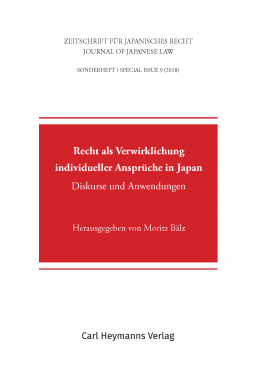
Law as Enforcement of Individual Rights in Japan: Discourses and Applications
Synopsis
A recurring theme in the treatment of Japanese law and its unique qualities is the question of whether the law in Japan is, in a way similar to the legal systems of continental Europe and common law countries, understood and practiced as the enforcement of subjective rights. This highly complex question served as the main theme of the Law Section at the 16th German Conference on Japanese Studies (the “Deutschprachiger Japanologentag”), which took place from 25 to 28 August 2015, at Ludwig Maximilian University in Munich. The articles in this special issue are based on the contributions made during the Law Section. They aim to document and deepen the extraordinarily fruitful exchange that took place within the proceedings and make it accessible to a broad professional audience.
It goes without saying that we cannot conclusively determine the extent to which a less deeply rooted concept of subjective rights can actually be considered a characteristic feature of Japanese law. Rather, the following seven articles and the preceding outline of the topic are intended to advance the discussion by differentiating the issues involved, by examining the discussion historically from different perspectives, and by offering concrete examples from both general civil law and specific areas of law.
[Excerpt from Foreword]
Chapters
-
Preface by the editor
-
Subjektive Rechte in Japan: politische Einforderung – gesetzliche Gewährung – prozessuale Durchsetzung. Ein Problemaufriss
-
Das Ringen um staatliche Souveränität und das Wirtschaftsrecht des StärkerenEuropa und der Markenschutz in Japan und Ostasien, 1884–1923
-
Translation subjektiver Rechte und die Bewegung für Freiheit und Bürgerrechte (jiyū minken undō)
-
Die Rolle des öffentlichen Rechts beim Schutz von Vertragspartnern in Japan
-
Aggressive Rechtsdurchsetzung in JapanDie Eintreibung und Rückforderung wucherischer Darlehenszinsen
-
Shareholder Value und die Durchsetzung von Aktionärsinteressen in Japan
-
Ein Kampf ums RechtCause Lawyering für die Interessen temporärer Arbeitsmigrant*innen in Japan
-
Subjektive Rechte auch für Tiere?Aktuelle Debatten und Prognosen über das Tierschutzrecht in Japan